Why Some Notes Sound BIGGER Than Others - P469
Jun 10, 2026Introduction
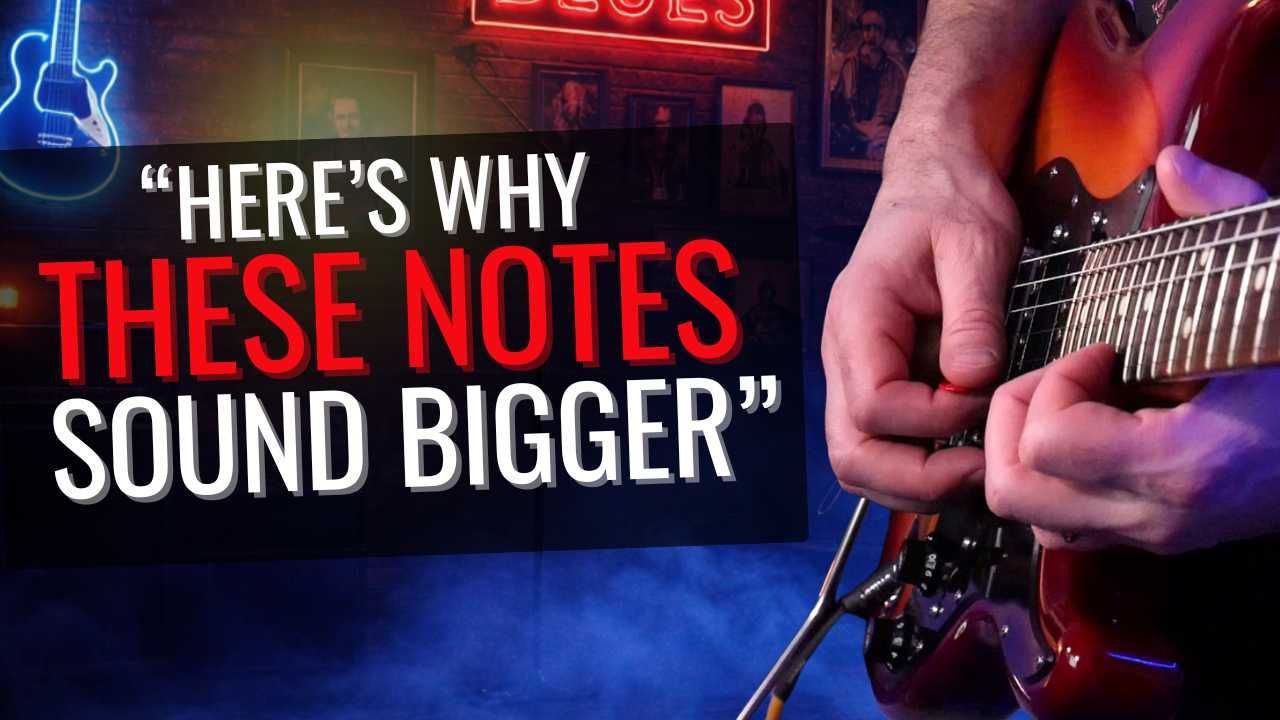
Why do some notes seem to jump out of a solo while others feel small, weak, or forgettable?
Many players assume the difference comes from technique, speed, or knowing more scales. In reality, a huge part of the answer comes from understanding that not all notes have the same importance.
In this episode, Lee explores why certain notes sound bigger than others, how great players create emotional impact with note choice, and how understanding note hierarchy can transform scales into real music.
YouTube Embed:
Podcast Embed:
What You'll Learn
- Why not all notes in a scale are equally strong
- How stable notes and tension notes create musical emotion
- Why chord tones carry more weight than scale patterns
- How target notes make solos sound intentional
- Why context changes the importance of every note
- How tension and release create expressive blues phrasing
- Why wandering through scales makes solos feel flat
- How using fewer notes can make your solos sound bigger
Not All Notes Are Equal
One of the biggest breakthroughs in soloing comes from realizing that scales are not collections of equally useful notes.
Some notes create stability. Others create tension. Some feel complete when you stop on them, while others demand that you continue moving toward a stronger destination.
For example, when a G chord is playing, a G note feels stable because it is the root of the chord. You can land on it confidently and it will sound resolved. Other notes may create friction, tension, or uncertainty until they move to a stronger note.
Understanding these differences changes the way you think about soloing. Instead of treating every note as equal, you begin hearing which notes deserve emphasis and which notes function as movement.
Stable Notes and Tension Notes
Tension is not a problem. In fact, tension is one of the most important tools in expressive music.
Some notes create a sense of uneasiness that naturally wants to resolve. When used intentionally, these notes add excitement, emotion, and forward motion to your solos.
The key is learning to hear the difference between stable notes and tension notes. A note that sounds harsh or unstable on its own can become incredibly powerful when it resolves into a stronger chord tone.
Great players are constantly balancing tension and release rather than simply running scales.
Stop Practicing Scales Without Listening
A common mistake is practicing scales mechanically without paying attention to how each note sounds against the chord underneath.
Lee recommends listening carefully to every note and identifying which notes feel strong, which notes feel weak, and which notes create tension.
If you cannot hear the emotional function of each note, you are unlikely to use those sounds intentionally in your solos. Instead, you'll end up moving up and down scale patterns without creating meaningful phrases.
Focus on Sounds, Not Shapes
Many players become trapped in visual patterns and fretboard shapes.
While shapes are useful, the real goal is understanding the sound and function of the notes inside those shapes.
Within a chord, the root, third, and fifth each have their own personality. The root often sounds strong and stable. The major third creates a sweeter, brighter quality. The fifth reinforces the harmony and naturally supports the root.
Learning to hear these differences helps you make more intentional musical choices.
Context Changes Everything
A note that sounds perfect over one chord can sound completely wrong over another.
This is why soloing cannot be reduced to memorizing a scale pattern. The harmony underneath determines how each note functions at any given moment.
As chords change, the importance of individual notes changes with them. Great players constantly adjust their phrasing based on the chord progression rather than relying on fixed patterns.
Great Players Hear Destinations
Experienced improvisers rarely play random notes.
Instead, they hear destination notes and build phrases toward them. They understand where the line is going before they arrive there.
Not every lick has to be the highlight of the solo. Just like verses lead into choruses, simpler phrases can build anticipation for stronger musical moments later.
Thinking in terms of destinations creates structure, purpose, and direction in your solos.
Target Notes Make Solos Sound Intentional
One of the easiest ways to sound more musical is to begin targeting important chord tones.
Rather than treating every note equally, identify specific notes within the chord and aim for them during your phrases.
Lee discusses targeting the flat seventh over dominant seventh chords as an example of a note that immediately communicates the sound and character of the harmony.
When listeners hear these target notes, the solo feels connected to the music instead of floating above it.
Tension and Release Create Emotion
Emotion comes from contrast.
Tension notes create expectation. Resolution notes satisfy that expectation.
The longer a player delays resolution, the more emotional impact the release can have. Great improvisers consciously control this process rather than leaving it to chance.
This is one of the major reasons some solos sound expressive while others feel flat.
Why Solos Often Feel Flat
Many players unknowingly make their solos feel smaller by wandering through scale patterns without a clear destination.
When every note receives equal treatment, none of the notes feel important.
Without target notes, chord awareness, or intentional phrasing, listeners hear movement but not meaning.
The solution is not learning more scales. The solution is learning how notes function within the harmony.
Make Fewer Notes Sound Bigger
One of the most powerful ideas in this episode is that fewer notes often create more impact.
A small phrase played with intention can sound larger, more emotional, and more memorable than a long run through a scale.
By slowing down, targeting strong notes, and creating purposeful phrases, your solos begin to sound bigger even though you may actually be playing less.
Practice Assignment
Choose a backing track and focus on a single chord.
- Identify the root, third, fifth, and seventh of the chord.
- Play each note individually and listen to its character.
- Experiment with notes a half step away from those chord tones.
- Create tension by landing on those notes and then resolving to a chord tone.
- Build short phrases that target specific chord tones rather than running scales.
- Try creating an entire solo using fewer notes while focusing on note importance.
Continue Your Training
- Play Guitar Academy
- 1-ON-1 Guitar Lessons & Coaching
- Blues Solo Breakthrough
- Play Guitar Academy YouTube Channel
- Play Guitar Podcast on Spotify
- Play Guitar Podcast on Apple Podcasts
- Play Guitar Academy on Instagram
- Play Guitar Academy on Facebook
- Play Guitar Academy Facebook Group
Related Lessons
- How Do I Start Using Chord Tones When I Solo?
- 5 Licks to Target the Right Notes in Your Blues Solos
- Mixing Major and Minor Pentatonic Scales
- What's Missing From Your Pattern 1 Solos?
- Why Great Blues Players Never Outgrow Pattern 1
Transcript
Welcome, friends, to the Play Guitar Podcast. I am Lee, and I'm here to help you become the guitar player that you've always wanted to be.
We've got a cool set of lessons and podcasts this week. If you've ever played the exact same scale as a great player, or the same lick, or the same song, but somehow the notes they're playing sound more meaningful, they hit just right, most people assume you're doing something wrong. You're missing a technique.
Often, what you're missing is an understanding of the importance of each of these notes.
Today, we're exploring why some notes feel bigger than others and how that changes the way you approach soloing.
If you're a studious guitar player, if you're someone who spends a lot of time learning your scales and your chords, and you're super frustrated because you've learned all this stuff and it doesn't sound quite right, well, you're in the right place.
There's a change in thinking that could really help you with this.
Not all notes feel equal.
Just because you're playing a scale doesn't mean they're all equally good.
Some notes create stability.
Root notes, for example. If you're playing a G chord and you play a G note, that's going to match perfectly. It's the strongest note of the chord.
That's going to be stable. You can go to that note any time while that chord is playing, and you're going to have a stable sound.
But some notes don't do that.
Some notes, even notes that belong to the scale, create tension.
Take a note that's a half step away from a strong chord tone. If you're playing a G chord and then introduce an F#, you create the sound of a major seventh. That little bit of friction creates tension.
In blues, you might play a dominant seventh chord and use the minor third. Inside a blues lick, it sounds right. But when you isolate the note against the chord, you can hear the tension.
Some notes demand to be resolved.
They may not sound perfect by themselves, but they lead beautifully into notes that do. That tension and release is something listeners enjoy.
We need to start looking at notes this way rather than thinking only in scales and chords.
If you're in the key of G and play a G scale over the chord progression, all the notes belong to the scale, but they don't all function equally.
Some notes are stronger than others.
And when the chords change, the importance of those notes changes too.
One of the biggest mistakes players make is treating every note equally.
Another mistake is practicing scales without listening.
One of the first exercises I give coaching students is to let the root note ring longer than the other notes when they practice scales.
Even better, practice scales over a chord and listen carefully.
Notice which notes feel stable and which notes feel tense.
Some notes don't sound great on their own, but they sound wonderful when used alongside stronger notes.
You need to hear that difference.
If you can't hear it, you're never going to use it intentionally in your playing. You'll just end up moving up and down scales like most players do.
Another common mistake is focusing on shapes instead of sounds.
You may know a particular chord shape on the fretboard, but that shape contains notes that each have a different musical function.
For example, in a D major chord, one note is the fifth, one note is the root, and one note is the major third.
Each of those notes creates a different emotional effect.
The major third has a sweet sound.
The root has a strong, grounded sound.
The fifth has a supportive sound that naturally complements the root.
You hear this relationship all the time in music. Bass lines often alternate between the root and the fifth because those notes work together so well.
Every note carries a different emotional quality.
Notes are how we communicate emotion through music.
The notes you choose determine what your listener feels.
If you understand what a note is doing and how it relates to the chord and key, you can take control of the emotion in your playing.
Even within a single chord, choosing a different starting note changes the feeling completely.
Starting on the major third creates a bright, open feeling.
Starting on the root creates a more stable and grounded feeling.
And we're not even talking about outside notes or tension notes yet.
Another important thing to remember is that context changes everything.
You can't play the same lick everywhere and expect it to have the same effect.
The importance of a note changes depending on the chord underneath it.
A note that sounds wonderful over one chord may sound terrible over the next chord.
The same pitch can completely change its function when the harmony changes.
That's why paying attention to the chord progression is so important.
Sometimes players rely too heavily on scale patterns and forget that the chords determine how those notes actually sound.
There are situations where a note sounds perfect over one chord but clashes badly when the progression moves somewhere else.
When borrowed chords or unexpected harmony appear, you have to listen and adjust.
You can't assume every note in the scale will always work the same way.
The context determines everything.
Another thing great players understand is that they're usually going somewhere.
There's a destination.
There's a payoff.
Not every phrase has to be the most important phrase in the solo.
Some phrases are simply setting up something larger that comes later.
Think about songs.
The verse often leads into the chorus.
The verse doesn't necessarily contain the biggest moment. It's preparing you for what comes next.
Soloing works the same way.
Some ideas exist to support the larger musical statement.
Some ideas create anticipation.
Some ideas build tension.
Some ideas lead directly toward a memorable destination.
Great players hear those destinations before they arrive there.
That's one reason their playing sounds intentional.
Let's move on to section two.
Why do great players sound like they're playing intentionally even when they're improvising?
The answer is that they're hearing things that many developing players haven't trained themselves to hear yet.
The first thing they're listening to is the chord underneath them.
They're not simply running a scale pattern.
They're listening to the harmony and responding to it.
If a major chord is playing underneath a minor pentatonic scale, a great player recognizes that there may be notes outside the scale pattern that better reflect the chord.
Because they're listening to the harmony, they're willing to add those notes when they hear them.
They aren't blindly moving up and down a scale.
They're making decisions based on what the music is doing.
Another thing great players hear is the pull of target notes.
When playing blues over a dominant seventh chord, certain notes naturally attract attention.
For example, over a G7 chord, one of my favorite target notes is the flat seventh.
The notes in a G7 chord are G, B, D, and F.
The F is the flat seventh.
That note immediately communicates the sound of the dominant seventh chord.
It's one of those notes that tells the listener exactly what harmony is happening.
When I play over a G7 chord, I often find myself aiming for that F note.
It has a distinctive sound.
It creates a sense of arrival.
It feels like a destination.
The same thing can happen with the major third.
You can hear phrases pulling toward those notes.
The line isn't random.
It's moving toward a target.
That's one of the reasons great solos sound intentional.
The player knows where they're going.
Another thing great players hear is the emotional effect of tension and release.
The longer you sit on a tension note, the stronger the feeling becomes.
If you stay on a note that creates friction, anticipation starts to build.
Eventually, when you resolve to a stronger note, the listener feels relief.
That emotional payoff is one of the most important elements in expressive soloing.
Tension and release are not accidents.
They're choices.
Great players intentionally decide when to create tension and when to release it.
Now let's talk about one of the hidden reasons solos often feel flat.
One of the biggest problems is wandering through scales without paying attention to the chords.
Many players spend years memorizing scale patterns.
Memorizing scales is useful, but it isn't the final goal.
Once the scale is memorized, that frees up mental space to focus on the music.
If you're no longer struggling to remember the pattern, you can start paying attention to the harmony.
You can start listening to the chord progression.
You can begin making musical decisions instead of simply reciting finger patterns.
Think of your scale as a road map.
The scale provides possible routes.
The chord tones are the destinations.
The scale helps you travel from one important note to another.
That's a very different mindset from simply running up and down a pattern.
Another issue that causes solos to feel small is having no clear destination.
If you're constantly searching for notes, none of them will sound important.
Everything feels uncertain.
Everything feels temporary.
But when you know exactly which note you're aiming for, that destination gains significance.
Even if the note you're targeting is simply the root, it still creates a sense of purpose.
The root is one of the strongest notes available.
You can build an enormous amount of confidence into your playing by knowing where the root is and returning to it when necessary.
In live performance situations, distractions happen all the time.
You hear people talking.
You hear things dropping.
You hear activity happening around the stage.
Sometimes you momentarily lose track of where you are.
When that happens, knowing the root note can save you.
If you're in the key of G, landing on a G is usually going to put you back on solid ground.
It's a reliable destination.
In fact, a large percentage of the time, returning to the root note will sound better than aimlessly searching for something more complicated.
The next thing that can dramatically improve your playing is relating your ideas to the music around you.
I don't usually prepare solos in advance.
I prefer listening to the musicians I'm playing with and allowing their ideas to influence mine.
If the bass player plays an interesting rhythm, I might borrow that rhythm and develop it.
If the singer delivers a phrase with a strong rhythmic shape, I might use that idea as inspiration.
The music itself becomes a source of ideas.
When you listen this way, your solos stop sounding mechanical.
Instead of sounding disconnected from the song, they become part of the conversation.
The other musicians provide an endless supply of inspiration if you're willing to listen.
Let's talk about a different way to think.
Stop asking what scale to use and start asking where the music wants to go.
Of course it's important to know what scale you're playing, but that's only the beginning.
The real question is what you're trying to do with those notes.
Playing the correct scale is not enough. You need to create meaning with it.
You need to hear the important notes.
One of the best ways to develop this skill is by practicing arpeggios over the chords you're playing.
Arpeggios contain the strongest notes of the harmony.
These are the notes that naturally sound stable and connected to the chord progression.
The more familiar you become with those notes, the easier it becomes to create phrases that sound intentional.
You can also practice creating tension and release around those notes.
Here's a simple exercise.
Take the notes of a chord and play a half step below each chord tone before resolving into the chord tone itself.
It doesn't matter whether the approach note belongs to the scale or not.
The purpose of the exercise is to train your ear to hear tension resolving into stability.
As you do this, you'll begin hearing why some notes feel stronger than others.
You'll also begin hearing how tension notes can become expressive tools instead of mistakes.
Another important concept is making every phrase mean something.
Many players fall into the habit of moving continuously through scale patterns.
The notes may be technically correct, but they often lack purpose.
If you catch yourself wandering through scales, stop.
Slow down.
Play only two notes.
See if you can create a phrase that feels complete using as little material as possible.
When you focus on fewer notes, those notes naturally gain more importance.
You start paying attention to timing, phrasing, dynamics, and destination.
Everything becomes more deliberate.
A short phrase with intention often sounds much bigger than a long run through a scale.
The first approach may contain all the right notes, but the second approach gives those notes meaning.
That's where musical weight comes from.
That's where emotional impact comes from.
The goal isn't to play more notes.
The goal is to make the notes you play matter.
When you begin hearing note importance, your solos start changing immediately.
You stop thinking of scales as patterns to memorize and start seeing them as collections of possibilities.
You begin hearing destinations.
You begin hearing tension and release.
You begin hearing the relationship between your notes and the chords underneath them.
That's one of the biggest shifts a blues player can make.
It transforms scales from practice material into music.
Instead of simply playing notes, you begin communicating ideas.
You begin shaping emotion.
You begin making choices.
And those choices are what make a solo sound expressive, intentional, and memorable.
Thanks for hanging out with me today.
I hope something we discussed made you think differently about your own playing.
I hope you listened to your own solos and started noticing which notes feel strong, which notes create tension, and which notes deserve more attention.
Today we explored why some notes seem to carry more emotional weight than others.
Understanding note importance is one of the biggest breakthroughs available to blues players because it changes the way you hear the instrument.
It helps transform scales into music.
The lesson from this week shows exactly how to use these ideas to make slow blues solos sound bigger, more powerful, and more expressive.
If you'd like a framework that helps you apply these concepts in your own playing, check out the Blues Elevation Toolkit linked in the description.
Thank you for spending some time with me today.
I enjoyed hanging out with you.
I'll see you in the next episode.